
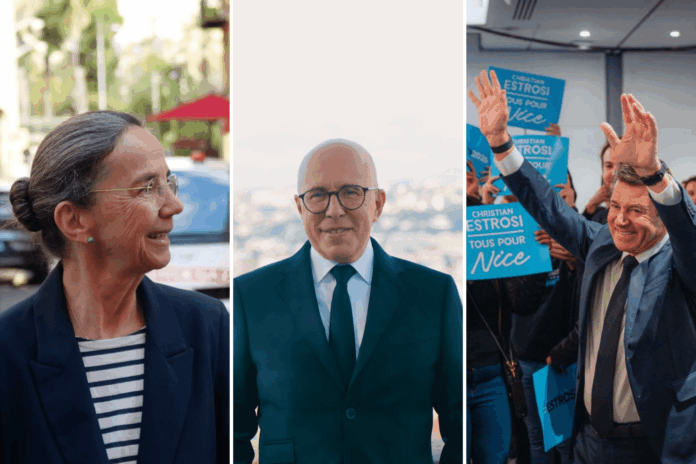
Due to the lack of direct confrontation, the three remaining candidates for the mayor of Nice defended their positions during separate interviews. Christian Estrosi, Éric Ciotti and Juliette Chesnel-Le Roux presented their arguments and priorities, each in a separate setting.
The second round of municipal elections in Nice took place without a debate between the finalists. Voters discovered the candidates’ positions through a series of recorded interviews. Christian Estrosi denounced this situation which he had nevertheless created in 2014 and 2020. The outgoing mayor claimed that Éric Ciotti had refused “transparency and democracy.” According to this analysis, the lack of confrontation prevented questioning certain proposals, particularly on taxation or major projects.
Éric Ciotti justified this choice. The candidate explained that he had already participated in debates before. He considered that the atmosphere of his debate evenings had deteriorated, evoking “increasingly violent confrontation.” According to him, the interview represented a way to express himself without insults.
Juliette Chesnel-Le Roux expressed a more nuanced position. The candidate recalled her commitment to direct debate between candidates while acknowledging that the interview format guaranteed balanced speaking time. This had clearly not been respected in the first round.
Christian Estrosi defends his record
Christian Estrosi centered his interventions on criticism of the opposing program. The outgoing mayor mentioned “three major lies” attributed to Éric Ciotti. The proposals for tax cuts were deemed unrealistic, particularly due to their cost. “Where will these 20% come from, which represent 50 million euros?” he repeated many times to address Éric Ciotti’s wish to lower the property tax. “He did not want this debate to take place so he would not have to answer these questions”, concluded the outgoing mayor.
The municipal record occupied an important place in his speech. His eighteen years in office were presented as a period of transformation for the city. Projects related to transport, security and the environment were highlighted. The candidate seeking re-election emphasized a 10% reduction in property tax: “I can commit to the people of Nice, without causing the least social damage throughout our administration, to give them back, starting next April, a 10% reduction in property taxes, because I know how to manage.”
Christian Estrosi also emphasized electoral momentum. The first round deficit (nearly 15,000 votes, editor’s note) was downplayed by regularly evoking the possible mobilization of abstainers to reverse the result.
Christian Estrosi sought to take back the initiative on proposals. The candidate highlighted direct democracy mechanisms, with regular local referendums and opening the finance committee to the opposition. The housing issue was also developed, with quantified allocation of planned construction in different sectors of the city. Security and risk management were recalled as priorities, with the expansion of surveillance systems and police equipment.
Éric Ciotti downplayed his political affiliation
Éric Ciotti developed a strategy focused on rupture. The candidate described the end of a political cycle when speaking about Christian Estrosi and associating him with a “system that is collapsing, which the people of Nice no longer want.” The theme of change structured his entire intervention.
The presentation of his list was intended to be cross-party, highlighting the diversity of profiles. The candidate very close to elected officials of the National Rally, Jordan Bardella and Marine Le Pen, since his departure from LR in 2024, no longer wanted to talk about political affiliation. A fact he downplayed in favor of a project presented as local. “My label in this election is Nice. My team is diverse. I still have on my list Jean-Marc Gouvernatori […] I have quality elected officials from the National Rally, like Colonel Benoît Candel, who was head of the gendarmerie in the Alpes-Maritimes. When Prefect Françoise Souliman commits, she is not a member of a political party.”
During his statements, several commitments were made. A reduction in property tax and a financial audit were proposed. Major projects, such as the tramway extension, were conditional on the budget situation: “we will do all this calmly. I hope there will be alternatives to the car.”
The candidate defended an approach presented as pragmatic, based on individual skills rather than party affiliations. The transport issue was addressed from a financial angle, with priority given to evaluating costs before any commitment. The desire not to increase taxes was reaffirmed, as was the idea of management refocused on available resources.
Juliette Chesnel-Le Roux wants to offer an alternative to the right
Juliette Chesnel-Le Roux adopted a different approach. The candidate denounced a “fratricidal duel” between the two main candidates. The campaign was described as dominated by confrontations rather than proposals. “The people of Nice saw there was a duel. They didn’t really understand that there were alternatives.”
Her continuation to the second round was assumed as a collective choice. The candidate insisted on the need to offer voters an alternative. The refusal of the republican front was justified by a local analysis of the political situation. “I felt the pressure, but since this is a project we led as a team and we discussed this subject well in advance, I continue with the decision that was made collectively.”
The priorities were refocused on ecology, housing and purchasing power: “the housing situation in Nice is such that there is real distress. Distress of women who are threatened by their husbands and who cannot leave their homes because they cannot find available housing, and distress of young people who would like to leave the family nest to live, to spread their own wings and who cannot do so.”
Juliette Chesnel-Le Roux detailed the role that an opposition can play in the municipal council. The experience gained by the candidate during previous terms was highlighted to defend a function of control and vigilance. The list leader also emphasized the need to act on the regulation of tourist rentals and mobilizing vacant housing were mentioned as levers for action. A topic often addressed by the list of Mireille Damiano who came 4th in the first round (8.95%) and did not qualify, with whom Juliette Chesnel-Le Roux did not wish to associate for ultimately very obscure reasons, even acknowledging a lie: “I lied a bit, because actually they wanted four seats out of ten.”
The ball is now in the voters’ court
The absence of debate did not allow for direct confrontation between programs. Each candidate presented his vision without immediate contradiction or really exposing the solutions he wished to implement to address the issues raised during the campaign.
Christian Estrosi defended continuity and experience. Éric Ciotti carried a line of change and rupture. Juliette Chesnel-Le Roux offered an alternative and a structured opposition role. The people of Nice are now called to vote this Sunday, March 22, 2026 to assert their choice with these elements of comparison between the different projects.
NicePremium is a free, independent local news outlet.
Help us keep going by supporting our work from €5 per month.


