
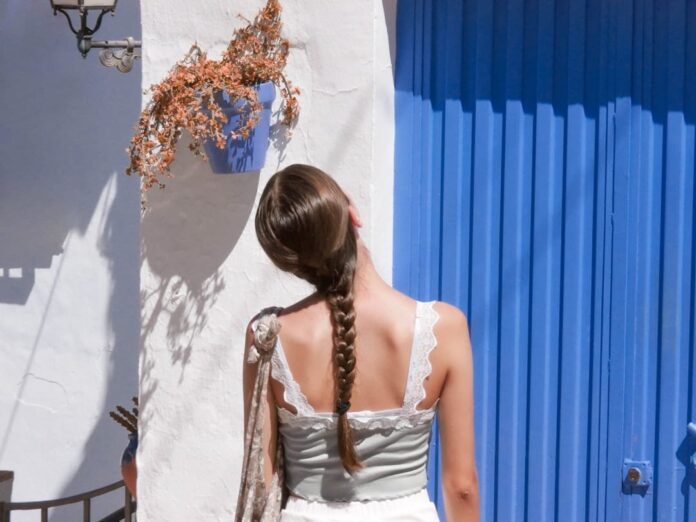
This summer, the Côte d’Azur imposes its own dress code. Far from flashy synthetics, natural materials — linen, pima cotton, wild silk — establish themselves as the true markers of a style that is both luxurious and conscious. From the Promenade des Anglais to the terraces of Cours Saleya, Nice becomes the living laboratory of a renewed Mediterranean elegance.
**Linen, undisputed king of Nice summers**
For several seasons now, linen has definitively shed its image as a wrinkled fabric to claim a prime place in the most refined wardrobes. Its ability to regulate body temperature makes it the ultimate material for days when temperatures hover around 30 degrees on the Côte d’Azur. Designers have understood this well: houses like Loro Piana — whose flagship boutique on the Côte d’Azur is located in Cannes, on Boulevard de la Croisette — offer high-quality linen shirts and trousers that work equally well during the day or at sunset.
The color palette draws directly from the Azure Coast landscape: pearly white, lagoon blue, Provençal ochre and terracotta dominate. This influence can be found in the summer collections of Jacquemus, a French designer from Salon-de-Provence, whose minimalist silhouettes have celebrated the light of the South since his beginnings. His micro-bag Le Chiquito, launched in 2018 and which became a global phenomenon, remains the signature accessory of the house — deliberately minimalist and ironic in its format.
**How to wear linen without looking casual?**
– Bet on the cut: wide linen trousers belted with a structured belt instantly transforms the silhouette.
– Play with layering: an unlined linen jacket over a silk dress creates a subtle dialogue between materials.
– Opt for monochrome: dressing entirely in the same linen from head to toe — a trend called tonal dressing — gives a decidedly contemporary look.
– Accessorize with architectural pieces: a raffia bag or natural leather sandals complete the outfit without weighing it down.
**Wild silk, a revisited heritage**
Less known than its classic counterpart, wild silk or tussah is making a strong comeback in high-end summer collections. More textured, less shiny, it offers a matte finish that suits Mediterranean light perfectly. Hermès, the house founded in Paris in 1837, has long made silk its signature material. Its iconic scarves — worn tied in the hair, around the neck or attached to a bag — remain collector’s pieces that transcend decades.
On the Côte d’Azur, this heritage is part of a tradition of discreet luxury that characterizes the Nice clientele. The boutiques on Rue Paradis and Avenue de Verdun, the heart of Nice’s luxury shopping, offer silk pieces ranging from oversized shirts to flowing evening dresses. Italian designer Miuccia Prada, through the Miu Miu line, has contributed to rehabilitating silk prints in both an intellectual and sensual register, blurring the boundaries between vintage and avant-garde.
**Pima cotton: elegance in the details**
Less spectacular than silk, pima cotton — cultivated primarily in Peru and Egypt — is nonetheless the material that increasingly seduces connoisseurs. Its extra-long fibers give it an incomparable softness and impeccable hold even after several hours of wear. Sunspel, the British house founded in 1860, has built its entire reputation on exceptional fabrics, notably with its T-shirts and its cult Riviera polo — the latter worn by Daniel Craig in the role of James Bond in Casino Royale in 2006.
In Nice, pima cotton appears in summer wardrobe essentials: the immaculate white shirt, the understated midi dress, the plain polo worn with pleated trousers. It is this claimed sobriety that defines the Azure style today: a luxury that reads in the quality of touch before displaying itself in a logo.
**The golden rules of a natural summer wardrobe**
– Invest in less, but better: three pieces in pima cotton are worth ten in polyester.
– Care for your materials: linen and silk should be washed at low temperature and dried in the shade to preserve their shine.
– Think of low-impact brands: brands like Veja or Sézane, whose traceability commitments are documented, offer pieces that fit this philosophy.
**Nice, natural stage for natural fashion**
It is no accident that the trend for natural materials finds such a strong echo on the Côte d’Azur. The city of Nice has always maintained a particular relationship with everyday elegance, inherited from both its Italian culture and its history as a destination for European high society. Cours Saleya, with its flower markets and terraces, offers the ideal setting for cream linen silhouettes or embroidered cotton. Castle Hill, the streets of Old Nice, the seafront towards Villefranche-sur-Mer: each place imposes its own palette.
This coherence between setting and clothing is precisely what photographer Slim Aarons celebrates, whose documentary work on the Mediterranean jet-set of the 1960s-1980s remains an inexhaustible aesthetic reference. His images of women in white dresses on terraces overlooking the sea resonate with particular acuity today, at a time when fashion is rediscovering the value of slowness and the natural.
**Where to shop these noble materials in Nice?**
Rue Paradis and Avenue de Verdun concentrate the addresses of major houses for established luxury. Rue de France and its surroundings offer multi-brand boutiques and some local designers working linen and cotton in small series. The Liberation Market occasionally hosts independent creators in small productions. Outside of Nice, Saint-Paul-de-Vence and its art galleries also house some fashion boutiques with an artisanal approach, where clothing dialogues with ceramics or art textiles.
**Towards sustainable and Mediterranean elegance**
The trend for natural materials is not simply a seasonal fashion effect: it reflects a profound shift in purchasing behaviors and aesthetic values. Choosing Provençal linen over shiny polyester is to assert a certain idea of beauty — anchored in territory, respectful of long-term thinking, indifferent to planned obsolescence.
The philosophy of slow fashion, theorized and popularized by authors like Orsola de Castro, co-founder of the Fashion Revolution movement, invites us precisely to reconsider each purchase as a meaningful act. And on the Côte d’Azur, where the sea and light impose their rhythm, this invitation takes on a particular resonance.
NicePremium is a free, independent local news outlet.
Help us keep going by supporting our work from €5 per month.


