
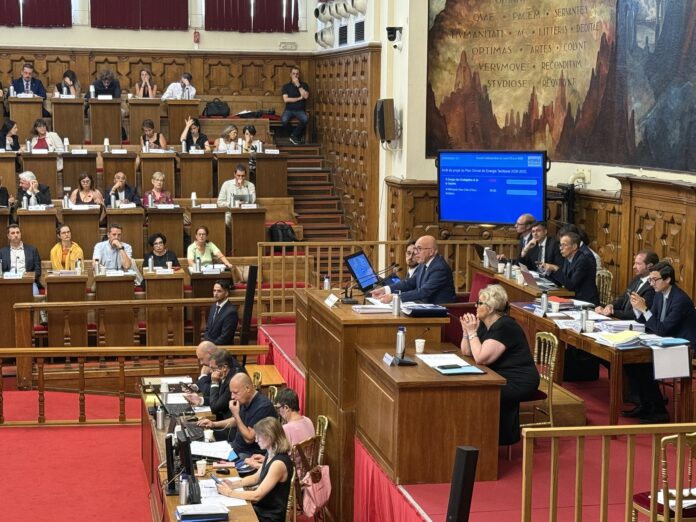
Meeting for the last time before the September return to school, the Metropolitan Council confirmed the arrival of new regulations for tourist rentals and decided on long-awaited ecological measures.
On the occasion of the Metropolitan Council on June 22, Nice Côte d’Azur Metropolis discussed public finances, housing and budget. Before the traditional summer break, metropolitan elected officials tackled contentious issues such as the thorny question of regulating tourist rentals.
An additional month of rental for tourist rental property owners
In a last-minute timeline for property owners, the Metropolis confirmed the outcome of the heated debates of the municipal council on Friday, June 19, moving from 90 to 120 days of authorized tourist rental for a primary residence, pending the development of a permanent metropolitan regulation applicable — the previous one having been suspended on January 29 by Christian Estrosi.
While the rental duration increases temporarily, the number of tourist rentals should, itself, decrease by the end of the year. A supposed temporary shrinking strategy of the rental stock that doesn’t convince everyone: “Working-class neighborhoods where the middle classes already struggle to find housing will have to support more tourist rentals”, laments socialist elected official Patrick Allemand, referring to the Old Town and city center, neighborhoods particularly affected by the phenomenon (recording +23% and +7% of such housing respectively), while the Port and Mont Boron neighborhoods seem spared, recording a 10% decrease in short-term rentals. This observation of imbalance is shared by the entire left-wing opposition group.
The new permanent metropolitan regulation should see the light in 2027, promised the official. Eric Ciotti declares he does not wish to “open the floodgates” of the tourist rental market in the meantime.
Reduction of travel and accommodation expenses for metropolitan elected officials
A final council marked by sobriety in terms of public spending. The Metropolis approved its “policy of sobriety and control of public spending” by voting for a reduction in reimbursement ceilings for meals and accommodations for elected officials.
The new term has instituted a one-third reduction in the reimbursement allowance set for elected officials’ meals, moving from 30 euros to 20 euros. A project approved unanimously.
This vote is accompanied by a new public auction measure selling eight unused vehicles owned by the Metropolis to the highest bidders. Sixteen other cars, in better condition, will be offered for sale to Metropolis and City employees only.
This considerable sorting is part of the “major savings plan” drawn up by Eric Ciotti at the outset of his appointment. On the objective of “60 million euros in savings intended to finance tax reduction (…) the sale of a number of official vehicles was supposed to allow total savings estimated at 500,000 euros” the Metropolis specified in a press release.
Adoption of the 2026-2032 Territorial Climate Air Energy Plan (PCAET)
The Metropolitan Council voted for the creation of an urban thermal network powered by sea thermal energy, a technology that transforms cold water drawn from the sea into energy that can heat or cool homes. The idea is inspired by similar systems existing in Monaco or even in Beaulieu-sur-Mer. The future network should provide more sustainable energy to part of the city extending from the Old Town to the entrance of Matisse Road, via the Port.
The PCAET aimed at accelerating the Metropolis’ ecological transition was voted unanimously. This is the third PCAET implemented by the public authority since 2013. For the deputy in charge of the environment Jean-Marc Governatori, “there will be no comparison between the results of the old plan and the new one.”
On the agenda, measures to improve modes of transportation and air quality by limiting greenhouse gas (GHG) emissions. A large consultation was held for three months to co-build this plan with the residents of the Metropolis.
Green elected official Juliette Chesnel-Le Roux however has some reservations about the will to implement this plan. Successively recalling the abandonment of the extension of tram line 4 and the air pollution alert of May 28, the elected official highlighted the municipality’s desire to increase airport activity while the volume of coastal transport already generates 45% of GHG emissions on the territory.
NicePremium is a free, independent local news outlet.
Help us keep going by supporting our work from €5 per month.


